
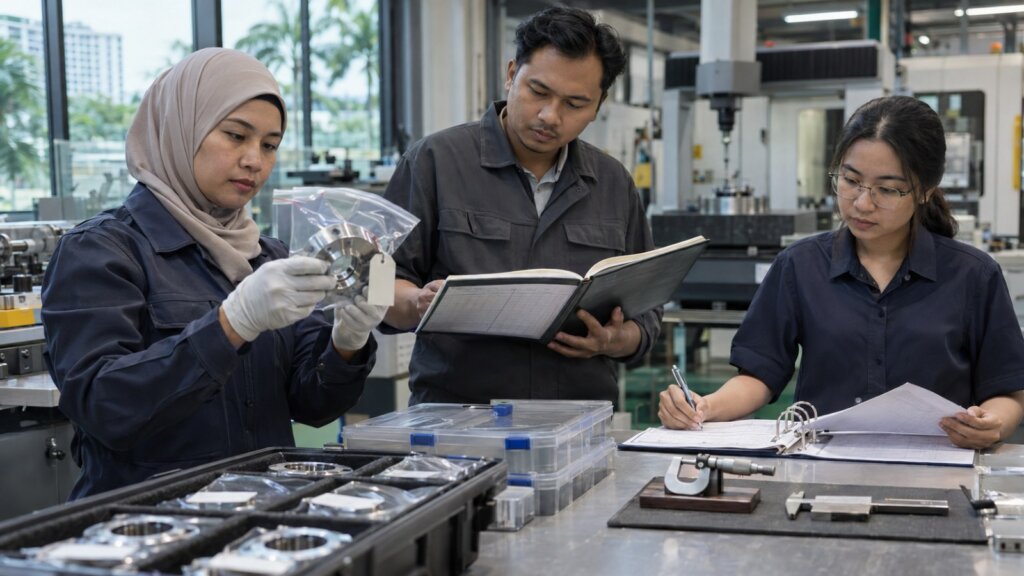
A company completes an important production milestone. The operations team records the result, a laboratory examines product samples, the finance department checks supporting figures, and the corporate communications team prepares the final documents. By the time the achievement is submitted for recognition, evidence has passed through several hands.
Every document may appear credible. Yet an important question remains: can the company explain where each item originated, who handled it, and whether the version submitted is the same evidence originally collected?
This is the purpose of an evidence chain of custody. For organisations preparing an Asia Record application, a clear custody history can help make supporting materials easier to trace, understand and assess.
Not every application requires a formal custody register. Nevertheless, applicants managing physical samples, multiple departments, external laboratories or complex digital records may benefit from documenting evidence transfers before confusion develops.
What Is an Evidence Chain of Custody?
An evidence chain of custody is a documented history showing how an evidence item was collected, controlled, transferred, stored and handled.
It connects the original source of an item to the material eventually presented for assessment.
For example, a manufacturing company may need to establish that a laboratory report relates to the exact product sample collected during a particular production run. A custody record can connect the sample identifier, collection event, delivery to the laboratory and final report.
Similarly, an event organiser may need to establish which team collected attendance records, when those records were transferred, and whether the final attendance summary corresponds to the original registration information.
The principle is straightforward: evidence should remain identifiable throughout its journey.
Asia Record’s official verification guidance explains that proposed achievements are assessed through clearly defined claims, supporting evidence and consistent measurement conditions. A custody register can support that process by helping applicants explain the history of relevant materials.
It does not, by itself, prove that an achievement qualifies for recognition or that the claimed result is correct.
Why Evidence Custody Matters for Record Applications
1. It establishes the origin of supporting materials
A spreadsheet, photograph or measurement report is more useful when its source can be identified.
Applicants should be able to explain who created the original record, when it was produced, what activity it documents and how it relates to the proposed achievement.
For business records, this may involve connecting transaction reports to the relevant operational system. For physical achievements, it may involve identifying the equipment, sample or measurement location.
2. It reduces confusion between originals and working copies
Evidence often needs to be reviewed, summarised or reformatted before submission. These activities are not inherently problematic, but they can create uncertainty if the original material is replaced or mixed with edited versions.
A custody process should distinguish source evidence from working copies and final presentation files.
3. It clarifies responsibility
When several departments participate in an application, employees may assume another team is responsible for preserving the originals.
Assigning a named custodian to each important evidence item reduces that ambiguity.
4. It makes questions easier to resolve
Asia Record may request clarification or additional supporting material when an application is incomplete.
An organised custody history can help an applicant locate the relevant original record, identify the person responsible and explain how a submitted document was prepared.
Which Evidence Items Should Be Tracked?
Not every supporting document needs the same level of control. Applicants should prioritise materials that are difficult to recreate, originate outside their organisation or directly establish the claimed measurement.
| Evidence type | Possible custody concern | Recommended control |
|---|---|---|
| Physical product sample | Sample identity or condition changes during transfer | Unique sample ID and receipt record |
| Original measurement sheet | Unclear authorship or later alteration | Dated original and named custodian |
| Laboratory report | Report cannot be linked to the submitted sample | Matching sample and report references |
| Event attendance records | Different teams maintain competing versions | Controlled source register and handover log |
| Digital photographs or video | Original files become mixed with edited exports | Original-file archive and version identification |
| Third-party confirmation | Origin or authority of the issuer is unclear | Issuer details and documented receipt |
This table is an editorial evidence-management guide. The appropriate controls depend on the achievement and the materials involved.
How to Build an Evidence Chain of Custody
Step 1: Assign a unique identifier to each important item
Begin by creating an evidence inventory. Each item should have an identifier that remains consistent across storage locations, handover records and the final submission.
For example, an internal reference such as PROD-SAMPLE-001 can distinguish one manufacturing sample from other samples collected during the same project.
Digital evidence can be identified through a controlled filename, source-system reference or document register.
The identifier should be sufficiently specific to prevent confusion between similar items.
Step 2: Record how the evidence was originally collected
Document the source, collection date, location, responsible person and purpose of collection.
For a physical sample, the collection record may describe the production batch, collection method and initial condition.
For a digital report, it may identify the source system, reporting period, person who generated the export and the original filename.
Records should be made as close to the collection event as practical. Reconstructing details weeks later can introduce avoidable uncertainty.
Step 3: Appoint an evidence custodian
An evidence custodian is the person responsible for controlling a particular item or collection of items.
The custodian does not necessarily need to be the person who created the evidence. Their responsibility is to know where it is stored, who can access it and how its handling history is documented.
For a small company, one project coordinator may manage the entire register. A larger organisation may assign departmental custodians and one central submission coordinator.
Step 4: Record every significant handover
When an item moves between people, departments or external organisations, record the transfer.
A useful handover entry identifies the item, releasing person, receiving person, date, time, destination and reason for transfer.
For physical items, note the condition on receipt where relevant. If packaging is damaged or identification is unclear, record the observation rather than silently correcting it.
For digital files, distinguish between transferring a copy and transferring responsibility for the controlled original.
Step 5: Protect original evidence
Preserving originals is especially important when evidence may be reviewed repeatedly.
Store physical materials under conditions appropriate to their nature. Use secure locations and access controls where necessary.
For digital evidence, retain original exports separately from working files. Limit editing permissions and maintain backups appropriate to the organisation’s security requirements.
Where justified, technical controls such as cryptographic hashes can help demonstrate whether digital files have changed. These controls should be implemented by personnel who understand their limitations.
Applicants should also respect applicable privacy, confidentiality and record-retention obligations.
Step 6: Document transformations and derived reports
Some supporting documents are created from original evidence rather than collected directly.
A consolidated transaction report, for example, may be derived from several system exports. An event summary may be calculated from individual registration records.
The custody register should identify the underlying sources and the person responsible for producing the derived document.
Keep enough information to explain the transformation without confusing the summary with the original source material.
Step 7: Reconcile the final submission with the inventory
Before submitting an application, compare the evidence package with the custody register.
Check that each important item is identifiable, that its source is documented, and that the submitted version corresponds to the intended supporting material.
Any unresolved gaps should be investigated and described accurately. Do not create retrospective handover entries that imply an event was documented at the time when it was not.
Example Evidence Chain-of-Custody Register
The following register illustrates a practical format that applicants can adapt for internal use.
| Field | Information to record |
|---|---|
| Evidence ID | Unique identifier for the item |
| Description | Nature and purpose of the evidence |
| Original source | Person, system or organisation that produced it |
| Collection details | Date, time, location and collector |
| Current custodian | Person responsible for the item |
| Storage location | Physical location or controlled digital repository |
| Transfer history | Previous and receiving custodians, dates and purposes |
| Condition or version | Relevant physical condition or digital version details |
| Related evidence | Connected reports, samples or source records |
| Final submission reference | Location of the item within the application package |
A spreadsheet may be sufficient for a relatively simple application. More complex projects may benefit from a controlled document-management system with access logs and version histories.
The most important consideration is whether the register is accurate, consistently maintained and understandable to someone who did not participate in the original activity.
Practical Scenario: A Manufacturing Achievement in Malaysia
Consider a hypothetical Malaysian manufacturer preparing evidence for an unusually large production achievement.
The production team collects operating records. A quality coordinator preserves inspection documents. Selected product samples are sent to an external laboratory, while management prepares a consolidated production summary.
Without a custody system, the company may have difficulty connecting the laboratory’s findings to the specific production batch or establishing which version of the production summary was used.
A better approach is to maintain separate but connected records for production data, physical samples, laboratory documentation and management calculations.
Each item receives a consistent identifier. The company documents relevant transfers and identifies the originals from which its final submission was prepared.
This does not establish that the manufacturer has achieved an Asia Record. It provides a more traceable basis for presenting the claim for assessment.
Practical Scenario: A Multi-Team Event in Singapore
Consider an event organiser coordinating registration, venue operations, participant counting and independent observation.
Different teams may collect different kinds of evidence. Registration data could be held by a technology provider, attendance observations by venue staff, and photographic material by a production contractor.
The organiser should establish which materials are authoritative for each purpose and who is responsible for transferring them to the central project team.
A custody register can document when each dataset or original media collection was received and whether any later processing occurred.
Importantly, evidence custody and measurement accuracy are separate questions. A perfectly documented attendance file may still contain duplicate registrations or inaccurate counts.
Applicants must address both the reliability of the underlying measurement and the traceability of the evidence used to support it.
Who Should Be Responsible for Evidence Custody?
Clear responsibility is particularly important when an achievement involves multiple organisations.
| Role | Suggested responsibility |
|---|---|
| Project owner | Defines the evidence collection scope and appoints responsible personnel |
| Evidence custodian | Maintains the inventory, storage controls and transfer records |
| Evidence creator | Records the origin and collection circumstances |
| External provider | Identifies materials supplied and documents relevant handovers |
| Submission coordinator | Checks that final documents match the evidence inventory |
These are suggested project roles, not mandatory positions prescribed for every Asia Record application.
Common Evidence Custody Mistakes
Replacing original files with edited versions
A communications team may resize photographs or combine reports for presentation. Those changes should not eliminate access to the original source material.
Using inconsistent identifiers
A sample may be assigned one reference by the manufacturer and another by a laboratory. The relationship between those references should be documented.
Leaving transfers undocumented
An evidence item may pass through several employees without anyone recording who received it. Important handovers should be documented when they occur.
Assuming a signed document proves the underlying result
A signature can help establish responsibility or receipt. It does not automatically establish that the measurement, calculation or claim is accurate.
Reconstructing missing information without disclosure
When a custody gap is discovered, applicants should investigate it using available records. If the history cannot be fully established, the limitation should be described accurately rather than concealed.
Evidence Custody Checklist Before Submission
- Every important evidence item has a unique identifier.
- The source and collection circumstances are documented.
- A responsible custodian is identified.
- Significant handovers have been recorded.
- Physical samples remain identifiable where applicable.
- Original digital files are distinguishable from edited copies.
- Derived summaries can be traced to their source records.
- External evidence can be linked to the relevant project or item.
- Any known gaps or discrepancies have been investigated.
- The final evidence package matches the evidence inventory.
Applicants should also confirm which evidence is relevant to their particular proposed record. A comprehensive custody register cannot compensate for evidence that does not demonstrate the achievement itself.
How Evidence Custody Supports Asia Record Verification
Asia Record assesses proposed achievements using the defined claim, relevant measurement conditions and supporting evidence. Its official guidance explains that the required evidence depends on the nature of the proposed record.
Applicants can review the official Asia Record verification process to understand how evidence relates to assessment.
For organisations preparing submissions involving multiple evidence sources, a documented custody history can make it easier to explain the relationship between original materials and the final evidence package.
However, maintaining such a history does not guarantee acceptance, verification or recognition. The achievement must still be assessed against the conditions relevant to the proposed record.
Before applying, organisations should review the official Asia Record application guidance and confirm the appropriate evidence requirements for their proposed achievement.
Frequently Asked Questions
Is a chain-of-custody form mandatory for every Asia Record application?
The published general application guidance does not establish a universal chain-of-custody form requirement for every submission. Applicants should confirm the evidence and documentation requirements relevant to their proposed record directly with Asia Record.
Can digital evidence have a chain of custody?
Yes. Digital evidence custody can be documented through source identification, controlled storage, access records, version histories and transfer documentation. The appropriate controls depend on the sensitivity and importance of the files.
What happens if an evidence handover was not recorded?
The applicant should investigate the gap using available records, identify what can be reliably established and avoid inventing missing details. Whether further evidence is needed depends on the proposed record and the assessment.
Can an external laboratory or contractor hold evidence?
External organisations may possess or produce relevant supporting materials. Applicants should maintain clear identifiers and records connecting those materials to the achievement being submitted.
Does a complete chain of custody guarantee Asia Record certification?
No. A custody history helps establish how evidence was handled. It does not independently prove that the underlying achievement is accurate, comparable or eligible for recognition.
Where can an organisation begin an Asia Record application?
Individuals, businesses, organisations and institutions can review the official application process through Asia Record’s website. The Asia Record frequently asked questions also explain general application and verification matters.
Prepare Evidence That Can Be Followed From Source to Submission
A strong record application requires more than an impressive result. The supporting materials should make it possible to understand what happened, how the achievement was measured and how the submitted evidence relates to the original activity.
For organisations handling multiple files, samples, departments or external providers, a practical chain-of-custody process can improve accountability and reduce uncertainty.
The goal is not to create unnecessary paperwork. It is to ensure that important evidence remains identifiable and traceable throughout preparation.
If your organisation has a measurable achievement that may be suitable for recognition, review the official requirements and submit your nomination to Asia Record.