
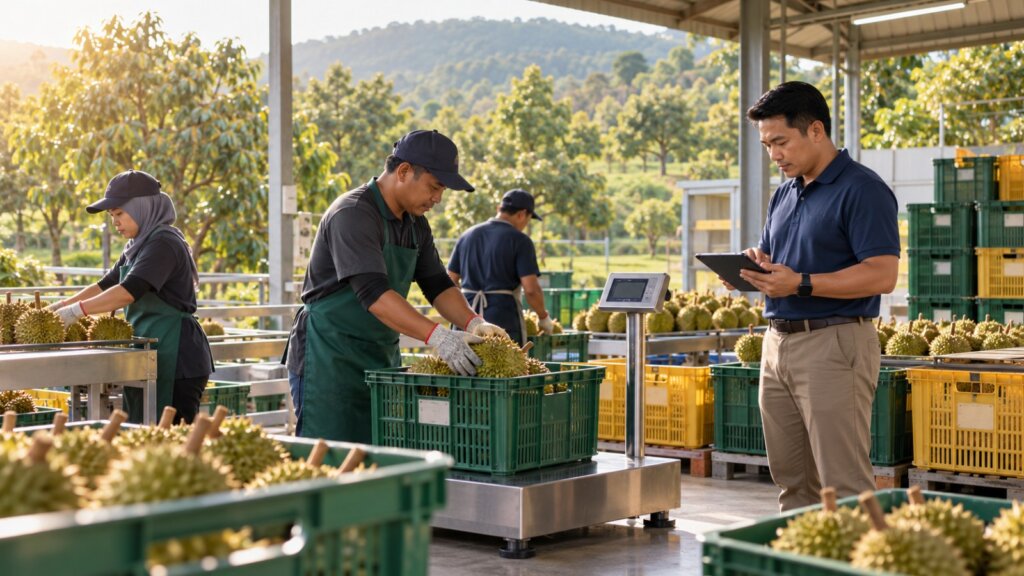
A durian processor turns one fruit into dozens of products. A plantation group brings a new sustainability programme into the field. An organic brand builds a catalogue of hundreds of certified items. A seafood business sells through an entire seasonal harvest in a few short months. Each of these is a real business achievement. But whether any of them can become an Asia Record depends less on how impressive it feels and more on whether it can be defined, measured and proven.
Agriculture poses particular challenges for record recognition. Output depends on weather and seasons. Products move through long chains of growers, processors and distributors. “Organic”, “premium” and “sustainable” mean nothing on a record title unless they can be evidenced. This guide explains which kinds of agricultural and agri-food achievements can be proposed, how verified Asia Record holders have framed theirs, and what evidence farms and agribusinesses should prepare before they apply.
Why Agricultural Achievements Need Careful Framing
Asia Record verifies an achievement by comparing a clearly defined record claim with supporting evidence and the conditions needed to measure it consistently. That principle applies to every sector, but three features of agriculture make it harder to get right.
- Seasonality. Many crops and seafood products have short, uneven selling windows. A claim must state which season, year or period it covers, and the records must match that window exactly.
- Shared value chains. A harvest may involve contract growers, cooperatives, processors and retailers. The applicant needs to show it has the authority to claim the achievement as its own.
- Quality labels. Words such as “certified organic” or “sustainably sourced” describe conditions that must already be supported by the relevant certifications or documentation. Asia Record recognition does not create or replace that status.
Get these elements right, and agriculture can produce some of the clearest, most numerical claims of any industry.
What Asia Record Looks For in Any Proposal
Asia Record accepts proposals from individuals, businesses, organisations and institutions. Every proposal is assessed on the same foundations. According to the official Asia Record verification process, submissions are reviewed for completeness, consistency, measurability, standardisation, verifiability and ethical execution. Verification is not a popularity vote. A well-known brand still needs evidence, and a small operator with strong records can make a credible claim.
An application should state the proposed record title, the applicant, a summary of the achievement, the measurement method, the date and location, and the evidence already available. Evidence should demonstrate three things: what was achieved, how it was measured, and the conditions under which it happened. Exact evidence requirements depend on the proposed record, so they should be confirmed with Asia Record before an attempt or submission.
Types of Agriculture and Agri-Food Achievements That Can Be Proposed
The table below sets out common types of agricultural achievement, how each might be measured, and the kinds of evidence that usually help. It is an editorial guide to help you frame a proposal, not an official list of approved record categories. Whether a specific claim is accepted is decided through Asia Record’s assessment.
| Achievement type | Example of a measurable basis | Evidence that typically helps |
|---|---|---|
| Downstream and value-added products | Number of distinct products made from a single crop, counted at a defined date | Product master list, packaging photographs, launch dates, sales or distribution records showing products were actually marketed |
| Certified product ranges | Number of products carrying a specific recognised certification under one brand | Valid certificates for each product, certification body details, product list reconciled to certificates |
| Seasonal sales or harvest volume | Units or tonnes sold or harvested within a stated season or year | Point-of-sale data, invoices, harvest logs, delivery orders, audited or management accounts covering the period |
| Production and processing output | Volume processed by a facility within a defined period | Production logs, weighbridge or calibrated-scale records, plant output reports |
| Grower and supply networks | Number of contracted farms, smallholders or cooperative members supplying one programme | Signed supply agreements, member registers, payment records, location data |
| Agri-technology and sustainability programmes | Area, number of farms or volume of input covered by a specific technology or programme | Deployment records, project reports, partner confirmations, field photographs and video |
| Aquaculture and livestock | Output, stocking or sales volume within a defined cycle | Stocking and harvest records, sales data, relevant licences |
| Agritourism and farm experiences | Visitor numbers or participants over a defined period or single event | Ticketing data, registration lists, gate counts, event footage |
| Single-specimen measurements | Weight, length or size of an individual fruit, plant or animal | Calibrated-scale readings, measurement video, independent witnesses, dated photographs |
What Verified Agri-Food Record Holders Show
Several entries in the official Asia Record Holder directory come from agriculture and agri-food. Their record titles show how a broad business story becomes a specific, checkable claim.
Durian Kingdom: counting the downstream product range
Durian Kingdom holds the title “Most Number of Durian Downstream Products in 2026”. Its published entry describes a portfolio spanning biscuits, chocolates, coffee, beverages, confectionery, pastries, frozen products, freeze-dried snacks and gift collections. The title works because it combines a single raw material (durian), a countable unit (downstream products) and a fixed year. For any processor building value-added lines from one crop, the lesson is to define what counts as a separate product before counting.
BMS Organics: a certification as a condition of the claim
BMS Organics is recognised for the “Largest Range of Certified Organic Products by a Single Brand”. Two qualifiers do the work here: the products must be certified organic, and they must sit under a single brand. That makes certification status part of the evidence, not a marketing description. A brand making a similar claim would need valid certification records for every product counted.
Maha Sawit: sustainability with an agricultural dimension
Maha Sawit holds the title “Most Integrated ESG and Sustainability Management Platform in 2025”. Its published entry also describes work on organic fertiliser technology under the IPR Intan Merotai Ginger Development Project in Sabah. The record title focuses on the platform, not on every activity the company undertakes. That shows how a business with many initiatives should choose one clearly defined claim rather than trying to capture everything in a single title.
HEXTAR Industrial Chemical: defining the comparison group
The HEXTAR Industrial Chemical entry carries the title “Largest Range of Industrial Chemical Products by a Listed Company”, and its published description refers to the agribusiness sector among the industries served. The phrase “by a Listed Company” narrows the comparison set. Agri-input suppliers can use the same approach to make a “largest” or “most” claim comparable and fair.
IWC Aquastic: when the season is the measurement window
IWC Aquastic was recognised for the “Highest Number of Hairy Crabs Sold by a Single Restaurant in 2025”, based on 16,436 hairy crabs sold in a single season. Hairy crab is a seasonal product with a short selling period. The 2025 season gave the claim a fixed window, and the sales figure gave it a precise number. Producers and sellers of seasonal fruit, seafood and other harvests can frame volume claims the same way.
Evidence Challenges Specific to Agriculture
Most agricultural applications that need more information run into the same few issues. Asia Record’s application guidance lists common reasons a submission may need more information: an unclear record title, an undefined measurement method, missing evidence, inconsistent dates, or an applicant who cannot demonstrate authority to make the claim. In agriculture, these tend to look like this.
Seasons that do not match the records
If a claim covers “the 2025 season”, the sales, harvest or production data must cover exactly that season, with clear start and end dates. Mixing calendar-year accounts with season-based harvest logs creates inconsistencies that are hard to reconcile later.
Products versus variants
Is a durian chocolate in two pack sizes one product or two? Different flavours of the same snack may count separately, while different weights of the same item may not. Decide the counting rule first, write it down, and apply it to the whole list.
Harvested, processed or sold?
Tonnes harvested, tonnes processed and tonnes sold are different measurements, each with different evidence. A title should name the one you can prove most completely.
Who owns the achievement?
Where a programme involves cooperatives, contract farmers or distribution partners, the applicant should be the party that ran and controlled the achievement. Supporting agreements or partner confirmations can show that authority.
Weights and measures
Any claim based on weight or size should rely on calibrated equipment, dated records and, where relevant, video and witness statements. Natural produce changes after harvest, so measurements should be taken and recorded at the time.
Record Recognition Is Not a Substitute for Certification
An Asia Record recognises a measured, verified achievement. It does not certify that a product is organic, safe, halal, sustainably produced or compliant with agricultural or food regulations. Those matters are handled by the relevant government agencies and accredited certification bodies. Where a record title depends on such a status, as with a range of certified organic products, the applicant must already hold the certification and provide it as evidence. Businesses should present an Asia Record alongside, never instead of, their regulatory approvals.
Editorial Checklist: Is Your Agricultural Achievement Ready to Propose?
Use this checklist to test your claim before you apply. It is an editorial planning aid, not an official set of Asia Record criteria.
- Specific: Does the proposed title name one crop, product group, programme or activity?
- Measurable: Is there a single number at the centre of the claim, with a stated unit (products, tonnes, units sold, hectares, farms, visitors)?
- Time-bound: Have you fixed the year, season or date the claim covers?
- Comparable: Have you defined the comparison group, such as a single brand, a single outlet, or a listed company?
- Evidenced: Can you produce original records that directly support the number, rather than estimates or marketing summaries?
- Authorised: Can you show that your organisation ran or controlled the achievement?
- Compliant: Do you hold any certifications or licences the claim depends on?
- Ethical: Was the achievement carried out responsibly, without harm to people, animals or the environment?
Common Mistakes to Avoid
- Proposing a title built on adjectives, such as “finest” or “most innovative”, with no measurable basis.
- Counting products that were developed but never commercially released.
- Combining several farms, brands or seasons into one figure without explaining how they relate.
- Submitting summaries in place of original logs, invoices or certificates.
- Relying on a lapsed or pending certification for a “certified” claim.
- Waiting until after harvest to think about evidence, when key measurements can no longer be repeated.
Think Your Agricultural Achievement Could Qualify?
If your farm, plantation, processing operation or agri-food brand has a result you can define and document, the next step is to review the official Asia Record application process. Prepare your proposed title, measurement method, dates, location and available evidence before you submit. Fees and service options vary depending on the record category and assessment requirements, so contact Asia Record for current information.
Frequently Asked Questions
Can a farm, plantation or agricultural cooperative apply for an Asia Record?
Yes. Asia Record accepts proposals from individuals, businesses, organisations and institutions. A farm, plantation group or cooperative may propose a measurable achievement, subject to eligibility and evidence requirements.
Can an individual grower apply?
Yes. Individuals may propose an achievement, provided it can be clearly defined, measured and supported by evidence.
Does an Asia Record confirm that my products are organic or certified?
No. Asia Record recognises a verified achievement. Organic, food safety, halal and other certifications are issued by the relevant authorities and certification bodies. If your record title depends on a certification, you need to hold it and provide it as evidence.
What evidence do I need for an agricultural record?
Evidence should demonstrate the achievement, how it was measured and the conditions under which it was achieved. Depending on the claim, this may include documents, measurement records, photographs, video, witness statements and credible first-party or independent sources. Exact requirements depend on the proposed record and should be confirmed with Asia Record. The Asia Record FAQ covers common evidence questions.
How much does it cost and how long does it take?
Application fees vary depending on the record category, assessment requirements and services requested, so contact Asia Record for current information. Assessment timing depends on the completeness of the submission and the complexity of the proposed record.