
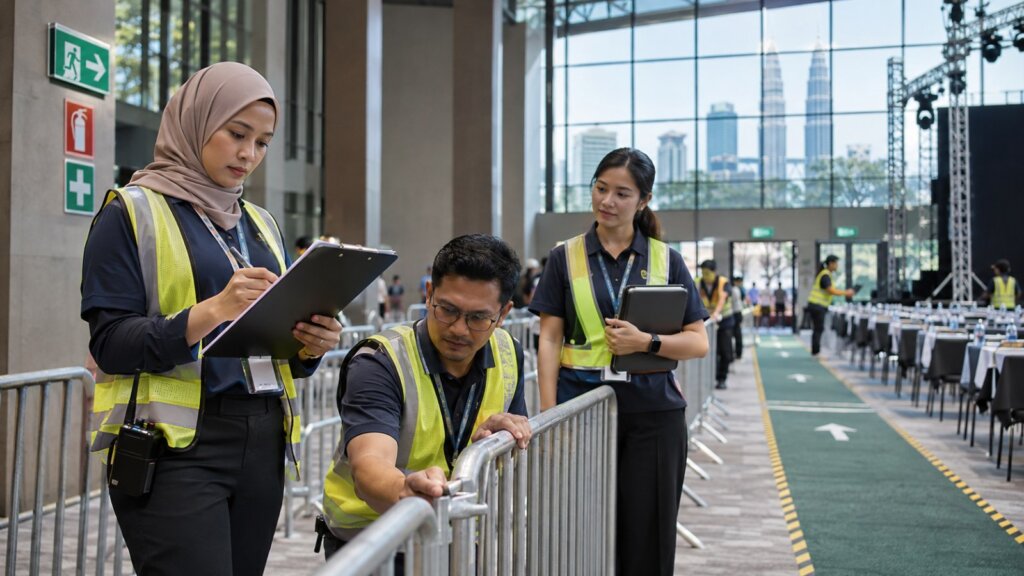
A record attempt can be carefully measured and extensively documented, yet still encounter serious problems if safety has not been planned with the same attention as the achievement itself.
Consider a company organising a large employee participation activity, a university attempting a coordinated performance, or a cultural organisation bringing hundreds of people together. Each may have a clearly defined target and a method for measuring success. But what happens if severe weather interrupts the activity, equipment becomes unsafe, or a participant requires urgent assistance?
These questions should be addressed before the attempt begins.
For organisations preparing an Asia Record application, a safety and risk management plan provides a practical way to identify hazards, assign responsibilities and establish clear decisions about whether an activity can proceed.
Asia Record’s official assessment principles include ethical execution, with the expectation that an attempt should not depend on unsafe or unlawful conduct. The exact requirements for each proposed achievement should be confirmed through Asia Record’s official verification guidance.
The following guide explains how organisers can prepare a proportionate safety plan without confusing operational safety responsibilities with record verification.
Why Safety Planning Matters for a Record Attempt
Record attempts often involve activities that would be relatively straightforward under ordinary circumstances but become more complex when conducted at an unusual scale.
A school may be familiar with supervising a classroom activity. Coordinating the same activity across a large hall introduces different considerations involving movement, space, supervision and emergency access.
Similarly, a company may routinely operate machinery or demonstrate products. Attempting an exceptional production or performance result can introduce additional pressure on equipment, workers and supervisors.
Safety planning helps organisers recognise these changes before they become operational problems.
A useful plan should answer five questions:
- What could reasonably cause harm during the attempt?
- Who might be affected?
- What measures will prevent or reduce the risks?
- Who has authority to pause or stop the activity?
- How will an emergency be managed and documented?
These questions are relevant whether the proposed achievement involves a small team, a production facility, an outdoor event or a large public gathering.
1. Define the Activity Before Assessing Its Risks
A safety assessment is only useful when the activity being assessed is clearly described.
Start by preparing a concise operational description covering:
- The proposed activity and its intended result.
- The location and physical environment.
- The expected number and profile of participants.
- The equipment, materials and temporary structures involved.
- The expected duration and operating schedule.
- The personnel responsible for supervising the activity.
- Any contractors, venue operators or external agencies involved.
For example, an attempt involving a coordinated outdoor performance should distinguish between the performance area, participant waiting area, spectator space, equipment storage and emergency access routes.
These distinctions matter because each area may introduce different hazards.
The operational description should also be consistent with the proposed record claim. If the activity changes substantially during preparation, both the safety arrangements and relevant measurement conditions may need to be reconsidered.
2. Identify Hazards Specific to the Attempt
Not every record attempt faces the same risks. Organisers should avoid relying entirely on generic event checklists that overlook the conditions of their particular activity.
A practical assessment can group hazards into several categories.
People and participant movement
Consider overcrowding, queues, fatigue, slips, falls, accessibility barriers, unsuitable participant activities and the needs of children or other participants requiring additional supervision.
Equipment and infrastructure
Consider electrical installations, moving machinery, temporary stages, structural stability, cables, lighting, sound equipment and the possibility of equipment failure.
Environmental conditions
Outdoor attempts in Southeast Asia may require particular attention to heavy rainfall, thunderstorms, heat, humidity, slippery surfaces and changing ground conditions.
Operational coordination
Consider unclear instructions, communication failures, insufficient staffing, contractor conflicts and participants entering restricted areas.
Emergency readiness
Consider whether first aid, emergency communications, evacuation routes and access for emergency responders are appropriate for the activity.
Where specialist risks are involved, such as work at height, industrial equipment or complex temporary structures, organisers should obtain advice from suitably qualified professionals.
3. Create a Practical Risk Assessment Register
A risk register helps turn a general discussion about safety into specific actions and responsibilities.
The following example is an editorial planning tool. It is not an official Asia Record assessment form.
| Potential hazard | Possible consequence | Proposed control | Responsible role |
|---|---|---|---|
| Heavy rainfall | Slips or unsafe outdoor conditions | Monitor conditions and establish postponement triggers | Event safety lead |
| Crowded entry area | Congestion or falls | Provide managed entry routes and suitable staffing | Venue operations lead |
| Electrical equipment failure | Injury or interruption | Use competent technicians and appropriate isolation procedures | Technical supervisor |
| Participant illness | Medical emergency | Arrange appropriate first-aid support and emergency access | Medical response lead |
| Communication failure | Delayed safety instructions | Provide tested backup communication arrangements | Operations coordinator |
Each identified hazard should also be assessed for likelihood and severity using a method appropriate to the organisation and activity.
Controls should be selected to eliminate hazards where reasonably practicable or reduce remaining risks to an acceptable level under applicable safety requirements.
Assign a responsible person to each action and confirm that the control is in place before the activity begins.
4. Establish Clear Safety Responsibilities
One of the most important decisions is identifying who can stop the activity.
An organiser may have a project director, event manager, technical team, safety personnel, measurement team and media crew. Their responsibilities should not be left to informal assumptions.
For larger or more complex attempts, a responsibility matrix can identify:
- Event director: Overall operational coordination and resource decisions.
- Safety lead: Monitoring hazards and recommending or initiating safety interventions.
- Technical supervisor: Equipment readiness and technical safety.
- Participant coordinator: Briefings, supervision and participant movement.
- Emergency coordinator: Emergency communications and response arrangements.
- Measurement coordinator: Recording the achievement under the agreed measurement conditions.
One person may hold several responsibilities at a small event, provided the workload and competence requirements remain appropriate.
The authority to stop unsafe activity should be explicit. A measurement target, publicity commitment or scheduled presentation must not prevent an authorised safety decision.
5. Define Stop, Pause and Restart Conditions
A safety plan should not simply state that the event will stop if conditions become dangerous. It should explain how that decision will be made.
Possible stop or pause conditions include:
- Severe weather affecting participant safety.
- Failure of critical safety equipment.
- Loss of safe crowd movement or emergency access.
- A medical emergency requiring the activity to stop.
- Unsafe structural or electrical conditions.
- Loss of essential supervision or communications.
Organisers should establish relevant thresholds with competent safety personnel and the venue operator. Some activities may require specialist monitoring, formal permits or immediate cessation under applicable rules.
Restarting should require confirmation that the hazard has been controlled, necessary checks have been completed and the authorised decision-maker has approved resumption.
For record purposes, an interruption may also affect the conditions under which the result can be measured. The organiser should separately confirm any implications for the proposed record with Asia Record.
6. Prepare an Emergency Response Plan
Emergency arrangements should be understandable to the people who may need to act on them.
A practical emergency response plan should address:
- How an incident will be reported.
- Who will assess the situation and initiate the response.
- How participants and spectators will receive instructions.
- Where people should move or assemble when evacuation is necessary.
- How emergency services will access the location.
- Who will communicate with the venue operator and relevant authorities.
- How the activity will remain suspended until safe conditions are restored.
Emergency procedures should be coordinated with the venue’s existing arrangements rather than developed independently of them.
For events involving substantial crowds, vulnerable participants or specialised activities, organisers may need additional professional advice and coordination with local authorities.
All arrangements should comply with the applicable laws and requirements of the country and location where the attempt takes place.
7. Brief Participants and Test the Arrangements
A safety document has limited value if participants and staff do not understand what they are expected to do.
Before the attempt, organisers should conduct a briefing covering the activity sequence, relevant hazards, restricted areas, emergency signals and reporting arrangements.
Instructions should be accessible and understandable to the intended participants. For multilingual groups, organisers should consider translated instructions or interpreters where necessary.
Complex activities may benefit from rehearsals or tabletop exercises. These allow teams to test communication channels, decision-making responsibilities and emergency scenarios without exposing participants to unnecessary risk.
A rehearsal should also identify practical problems such as unclear assembly points, blocked routes, inadequate staffing or conflicting instructions.
Any significant changes discovered during testing should be reflected in the final safety arrangements.
8. Keep Safety Documentation Separate From Record Evidence
Safety documentation and record evidence serve different purposes.
A safety plan demonstrates how organisers intend to manage the activity responsibly. Record evidence establishes what achievement occurred, how it was measured and whether the relevant record conditions were satisfied.
Some documents may be relevant to both purposes, but one does not automatically replace the other.
For example, an event may maintain:
- A pre-event risk assessment.
- Staff and participant briefing records.
- Equipment inspection or maintenance records.
- Incident and interruption logs.
- A record of decisions to pause or resume the activity.
- Measurement logs and supporting photographs or videos.
These records should be accurate, dated where appropriate and maintained under suitable access controls.
If an incident changes the circumstances of the attempt, document what actually occurred. Do not alter measurement records to conceal an interruption or imply that conditions remained unchanged.
Asia Record’s verification process considers the supporting evidence and relevant conditions of the proposed achievement. Applicants should confirm the specific evidence requirements before proceeding.
9. Review Safety Arrangements Before the Attempt Begins
A final readiness review should take place sufficiently early for outstanding safety issues to be resolved.
Organiser Safety Checklist
- Has the activity and location been clearly defined?
- Have relevant hazards been identified and assessed?
- Are risk controls implemented and checked?
- Are responsible personnel identified and competent for their roles?
- Are emergency access and evacuation arrangements suitable?
- Have participants and staff received appropriate instructions?
- Have critical equipment and communication systems been checked?
- Are stop, pause and restart responsibilities clear?
- Are necessary permissions and regulatory requirements addressed?
- Is there a process for recording incidents and operational changes?
- Have relevant record measurement conditions been clarified?
This checklist is a starting point, not a substitute for a site-specific professional risk assessment or legally required safety documentation.
Unresolved critical safety concerns should be addressed before the activity proceeds.
10. What Happens If the Attempt Cannot Proceed Safely?
Postponing or cancelling an attempt may be disappointing, particularly when participants, sponsors and media teams have already made arrangements.
Nevertheless, safety decisions must take priority over achieving a particular number or completing an event on schedule.
If the activity is interrupted, organisers should record the circumstances, identify what needs to change and reassess the plan before considering another attempt.
Where an interruption affects the proposed achievement, the applicant should seek clarification about the relevant record conditions rather than assume that a partial or restarted attempt will be accepted.
The objective is not to produce a record at any cost. It is to pursue a clearly measurable achievement through a responsible process.
How Safety Planning Connects With an Asia Record Application
Asia Record accepts proposals from individuals, businesses, organisations and institutions with measurable achievements.
According to its official application guidance, applicants should provide information about the proposed record, including the applicant, achievement summary, measurement method, date, location and available supporting evidence.
The assessment considers whether the proposed achievement is sufficiently clear, measurable and verifiable. The exact evidence requirements depend on the record.
Safety planning is an important operational responsibility, but applicants should not assume that a generic safety checklist satisfies every record-specific requirement.
Before organising an attempt, review the official Asia Record application process and clarify the relevant conditions and documentation with the team.
Organisations can also consult the Asia Record frequently asked questions for general information about applications, evidence and verification.
Frequently Asked Questions
Does every Asia Record attempt require a written safety plan?
The appropriate safety documentation depends on the nature of the activity, its risks and applicable local requirements. Asia Record’s public guidance emphasises ethical execution, but applicants should confirm any record-specific documentation requirements directly. Organisers remain responsible for meeting relevant safety obligations.
Who should prepare the risk assessment?
The organiser should ensure that the assessment is prepared or reviewed by people with suitable knowledge and competence. Complex or high-risk activities may require qualified safety specialists and input from venue operators or relevant authorities.
Can a record attempt continue after an equipment failure?
Only if it is safe and lawful to do so, following appropriate checks and authorisation. Whether the resulting achievement remains valid under the proposed record conditions is a separate verification question that should be clarified with Asia Record.
Should a safety incident be included in the record documentation?
Incidents should be documented accurately under the organiser’s safety procedures. Where an incident affects the attempt’s measurement, duration, participants or agreed conditions, that information may also be relevant to the record evidence.
Can a company apply for an Asia Record involving a physical event?
Businesses and organisations may propose measurable achievements. Eligibility and evidence requirements depend on the proposed record and its circumstances.
Prepare the Achievement and the Conditions Around It
A well-prepared record attempt combines a clear objective, reliable measurement, responsible operational planning and accurate documentation.
Safety management does not guarantee that an attempt will be completed without interruption. It does, however, help organisers make informed decisions, respond appropriately when conditions change and protect the people involved.
For companies, institutions and event organisers considering an achievement worthy of recognition, the next step is to clarify the proposed record and its evidence requirements before committing to the attempt.
Planning a measurable achievement? Visit Asia Record’s official website to submit your nomination and review the application process.