
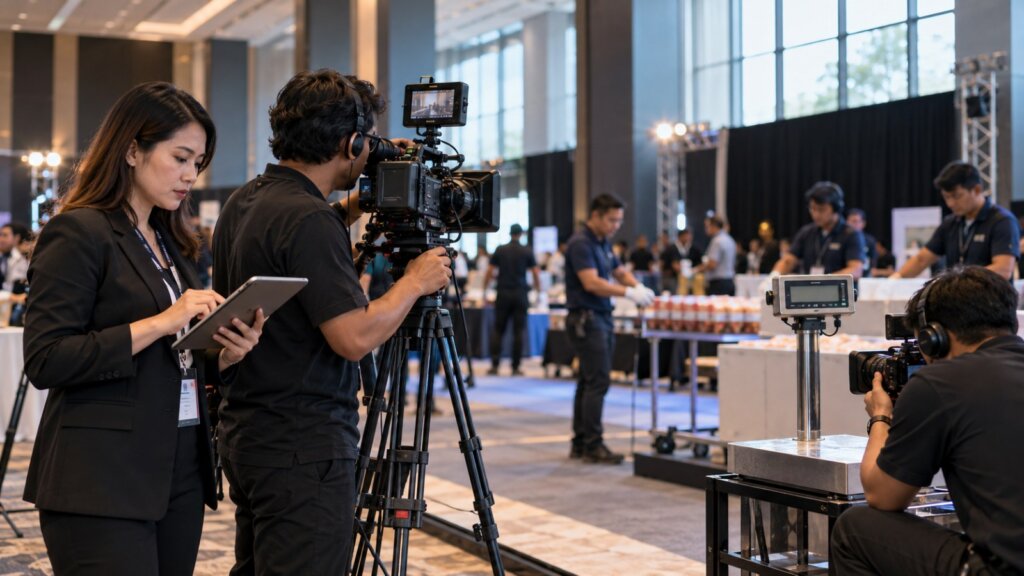
A record attempt may last only a few minutes, but the evidence collected during that time can remain important long after the event ends. A company might assemble hundreds of participants, a university might complete a large-scale educational activity, or a manufacturer might demonstrate an exceptional production result. In each case, the challenge is not simply capturing an impressive moment. It is documenting what actually happened.
Professional photographs can make an achievement memorable. However, a dramatic image does not necessarily establish an exact measurement, the conditions of an attempt or whether every relevant activity was completed.
For organisations preparing an Asia Record application, photography and video should therefore be planned as part of the evidence collection process, not treated solely as promotional material.
This guide explains how to capture useful visual documentation, avoid common recording problems and organise evidence so that it can be reviewed alongside measurements, records and other supporting information.
Why Photographic and Video Evidence Matters
Asia Record recognises measurable achievements proposed by individuals, businesses, organisations and institutions. Its official application guidance identifies photographs, videos, measurements, documents and witness statements among the types of supporting material that may be relevant to a proposed record.
The exact evidence requirements depend on the achievement being assessed.
Visual documentation can help establish several important facts:
- Identity: Who or what was involved in the achievement?
- Location: Where did the activity or measurement take place?
- Sequence: What happened before, during and after the attempt?
- Measurement: How was the claimed result determined?
- Conditions: What circumstances affected the measurement?
- Consistency: Does the visual evidence agree with the supporting documents?
For example, a photograph of a crowded convention hall may demonstrate that an event attracted substantial participation. It does not, by itself, prove the exact number of qualifying participants.
Likewise, a video showing a production line operating at high speed may illustrate manufacturing activity without establishing the total number of qualifying units produced.
The distinction is important: visual evidence should support a clearly defined claim rather than substitute for the measurement itself.
1. Define What the Camera Needs to Prove
Before deciding where to position cameras, organisers should identify the proposed achievement and its measurement method.
Consider three questions:
- What exact result is being claimed?
- Which actions or measurements establish that result?
- What would a reviewer need to see to understand how the result was achieved?
The answers should determine the recording plan.
For a mass-participation activity, relevant footage might show the participation area, the activity taking place and the method used to establish the qualifying count.
For a physical-size achievement, the most useful footage may show the measuring instrument, its placement, the object being measured and the resulting reading.
For a manufacturing achievement, the documentation may need to connect the recorded activity with production logs, inspection records and the relevant measurement period.
Practical principle: If a camera angle looks impressive but does not help establish a relevant fact, it should not be the only angle recorded.
2. Prepare a Photography and Video Shot List
A shot list gives the photography team a clear understanding of what must be documented. It also reduces the risk of discovering after the event that an important measurement was never captured.
The following is an editorial planning checklist, not a formal list of mandatory Asia Record evidence requirements.
| Stage | Recommended Visual Coverage | Purpose |
|---|---|---|
| Preparation | Venue, equipment, measurement setup and relevant preparation activities | Establish context and conditions |
| Before the attempt | Initial measurements, starting conditions and relevant participants or objects | Document the starting position |
| During the attempt | Wide-angle coverage and close-ups of important actions | Show how the achievement occurred |
| Measurement | Measuring instruments, counting processes and recorded readings | Connect the result to its measurement method |
| Completion | Final conditions, results and relevant observations | Document the outcome |
| After the attempt | Supporting records, evidence handover and file organisation | Help connect visual material with other evidence |
Organisers should adapt this checklist to the specific achievement. A long-duration activity may require a different recording arrangement from a single physical measurement or a short public event.
3. Use Wide Shots and Close-Ups for Different Purposes
Wide shots and close-ups answer different questions. A useful visual evidence package often benefits from both.
Wide shots establish context
A wide shot can show the overall activity area, arrangement of participants, surrounding conditions and scale of an achievement.
For a large gathering, an elevated camera position may help demonstrate how participants were distributed across the venue.
However, a wide shot may not reveal whether every person satisfied the relevant participation conditions.
Close-ups establish detail
Close-up footage can document measurement markings, instrument readings, counting actions, product identifiers or other details that are difficult to see from a distance.
For a physical measurement, the recording should make it possible to understand what was measured and how the instrument was used.
For an event involving many objects, close-ups may help connect the objects shown in the footage with an inventory or counting record.
Neither approach is universally sufficient. The objective is to produce complementary views that explain the achievement without leaving important gaps.
4. Record the Measurement, Not Just the Celebration
One of the most avoidable documentation mistakes is filming the announcement of a result without capturing how that result was established.
A video of an organiser announcing a final number may demonstrate that the number was publicly stated. It does not independently establish the underlying calculation.
Where practical and relevant, record the measurement process itself.
- Show the measuring instrument or counting system being used.
- Capture the relevant starting and ending conditions.
- Ensure important readings are visible and reasonably clear.
- Document who performed or observed the measurement where relevant.
- Preserve supporting records that explain the final result.
Suppose a business proposes an achievement based on the number of products processed during a defined period. Footage of employees working may provide useful context, but the result may also depend on production reports, transaction records or reconciled counts.
The visual material should help explain those records rather than suggest that footage alone establishes every unit processed.
For more information about the general application requirements, review the official Asia Record application process.
5. Plan for Recording Continuity
Recording interruptions can create uncertainty, particularly when an achievement depends on duration, continuous activity or a sequence of actions.
Before the attempt, organisers should assess whether continuous footage would help establish the proposed claim.
Useful preparations include:
- Checking camera batteries and available storage.
- Using stable camera supports where appropriate.
- Positioning equipment to avoid unnecessary obstructions.
- Preparing backup power or recording equipment for lengthy activities.
- Synchronising camera clocks where multiple devices are used.
- Assigning responsibility for monitoring recording equipment.
For longer activities, a secondary camera may help document periods when equipment needs attention. If recording gaps occur, they should be identified rather than concealed.
There is an important distinction between uninterrupted recording as a useful evidence practice and any specific continuous-recording requirement that may apply to an individual proposed record. Applicants should confirm the requirements relevant to their achievement with Asia Record.
6. Keep Original Footage Separate From Edited Videos
Organisations frequently produce highlight videos for publicity, social media and internal communications. These videos serve a different purpose from original evidence recordings.
A promotional edit may contain music, transitions, captions, slow-motion sequences and selected camera angles. It may be effective for storytelling while omitting the information needed to understand a measurement.
A sensible approach is to maintain two separate collections:
Original evidence files
These should preserve the recordings as captured, without replacing them with shortened or altered versions. Keep original file information where available and maintain an organised record of the source devices.
Edited communication materials
These may be prepared for media coverage, presentations or other approved communications, provided the edits do not misrepresent the achievement.
Retaining originals also allows an organisation to revisit a recording if a measurement, date or event sequence needs clarification.
For sensitive commercial or personal information, organisations should consider appropriate access controls and privacy obligations when storing or sharing footage.
7. Organise Evidence Files So They Can Be Reviewed
Even a well-recorded attempt can become difficult to assess if its evidence is scattered across phones, memory cards, messaging applications and cloud folders.
Organisers should create a consistent file-management system before the event.
A practical folder structure might separate:
- Original camera recordings.
- Original photographs.
- Measurement records.
- Supporting documents.
- Witness or observer materials, where relevant.
- An evidence index explaining the contents.
Use descriptive file names that identify the recording stage or subject. Avoid renaming files in ways that obscure their relationship to the original source.
An evidence index can be especially helpful when several cameras or departments contribute material.
| Evidence Item | Description | Related Supporting Material |
|---|---|---|
| Preparation video | Shows the measurement setup before the activity | Measurement procedure |
| Wide-angle recording | Shows the overall activity area | Event plan or activity log |
| Measurement close-up | Shows the relevant measuring action | Measurement record |
| Completion photographs | Documents the final condition | Result summary |
This table illustrates a possible organisational method. The actual evidence package should reflect the proposed record and the requirements communicated for its assessment.
8. Connect Visual Evidence With Independent Supporting Records
Photographs and videos become more useful when they can be matched to reliable supporting information.
For example, a large educational event might produce attendance records, registration data and a documented participation count. Video footage could then help establish what activity took place and under what conditions.
A company measuring an operational milestone might use system-generated reports or transaction records alongside footage of the relevant process.
The important question is whether the different evidence sources tell a consistent story.
If a video displays one measurement while a written report contains another, the discrepancy should be investigated before submission.
Similarly, if photographs were taken on a different date from the reported achievement, the difference should be explained where relevant.
Asia Record’s official application guidance advises applicants to preserve original records and provide clear measurement information. It also notes that additional information may be requested when a submission is incomplete.
9. Avoid Common Photography and Video Mistakes
Several preventable problems can reduce the usefulness of visual documentation.
Filming only the final result
Capture the process that establishes the result, not just the final announcement or celebration.
Using footage that is too distant
Wide shots may establish scale but fail to show measurement details. Add appropriate close-up coverage.
Allowing important actions to leave the frame
Position cameras around the actual measurement or activity rather than choosing angles solely for visual appeal.
Relying entirely on promotional edits
Preserve original footage so that selected highlights do not become the only surviving record.
Failing to document recording interruptions
Keep a record of relevant gaps, equipment changes or other interruptions instead of assuming they will not matter.
Using inconsistent dates or file descriptions
Check that the event summary, visual evidence and supporting documents refer to the same achievement and measurement period.
Collecting material without a clear owner
Assign responsibility for gathering, backing up and indexing evidence after the attempt.
10. Who Should Be Responsible for Visual Evidence?
For a corporate or institutional record attempt, visual documentation is often more effective when responsibilities are divided clearly.
The photography team should understand which activities and measurements require coverage.
The person responsible for the measurement should explain the process and identify the moments that matter.
The event or operations manager should coordinate access, timing and recording positions.
A designated evidence coordinator can then collect the original files, confirm that important material is present and maintain the evidence index.
These roles do not necessarily require separate employees. Smaller organisations may combine responsibilities, provided the documentation remains clear and reliable.
Where independent observations or witness materials are relevant, the arrangements should be consistent with the requirements applicable to the proposed record.
11. Final Visual Evidence Checklist Before Submission
Before submitting an application, use the following editorial checklist to review the photographic and video material.
- Is the proposed achievement clearly identified?
- Do the images and recordings show the relevant activity?
- Is the measurement process documented where practical?
- Can important readings or actions be understood?
- Are the relevant starting and ending conditions visible?
- Have recording gaps or unusual circumstances been identified?
- Are the original files preserved?
- Are photographs, videos and supporting records organised?
- Do dates, measurements and descriptions agree across the evidence?
- Has the team checked which evidence is required for the specific proposed record?
Completing this checklist does not guarantee recognition or replace the assessment process. It is intended to help applicants prepare clearer and more useful documentation.
From Visual Documentation to an Asia Record Application
Good evidence begins with a clearly defined achievement. The photography and video plan should then be designed around the measurement, relevant conditions and supporting records.
Asia Record’s official application process allows individuals, businesses, organisations and institutions to propose measurable achievements for assessment. Applicants provide details of the proposed record together with relevant supporting evidence.
The submitted claim and its evidence are assessed, and additional information may be requested where necessary. Asia Record communicates the recognition outcome following its assessment and verification process.
Organisations considering an application can review the official Asia Record FAQ for general questions about evidence and verification, or explore the official Record Holder directory to understand the types of achievements documented by the platform.
Planning a measurable achievement? Review the Asia Record application page before the event so that your team can prepare the relevant documentation in advance.
Frequently Asked Questions
Do I need photographs and videos for an Asia Record application?
Asia Record identifies photographs and videos among the types of supporting evidence that may be relevant. Exact requirements depend on the proposed record. Applicants should confirm which materials are appropriate for their achievement.
Can I use footage recorded on a smartphone?
Smartphone footage can be useful when it clearly documents the relevant activity or measurement. However, applicants should confirm any specific technical or evidential requirements with Asia Record rather than assuming that a particular device or recording format will automatically be accepted.
Is an edited highlight video enough to prove a record?
A highlight video may help explain an achievement, but it may omit important details. Preserving original recordings and supporting measurement records is a sensible practice. The required evidence depends on the proposed record.
What should I film during a record attempt?
Prioritise the activity being measured, relevant starting and ending conditions, the measurement process and any circumstances necessary to understand the claimed result. The recording plan should follow the nature of the achievement.
What happens if some footage is missing?
Missing footage may limit what can be established from visual evidence. Other documentation may help explain the achievement, but applicants should not assume that it will resolve every gap. Asia Record may request additional information during assessment.
Where can I apply for Asia Record recognition?
Individuals, businesses, organisations and institutions can begin by visiting the official Asia Record application page, which explains the nomination process and the supporting information applicants should prepare.