
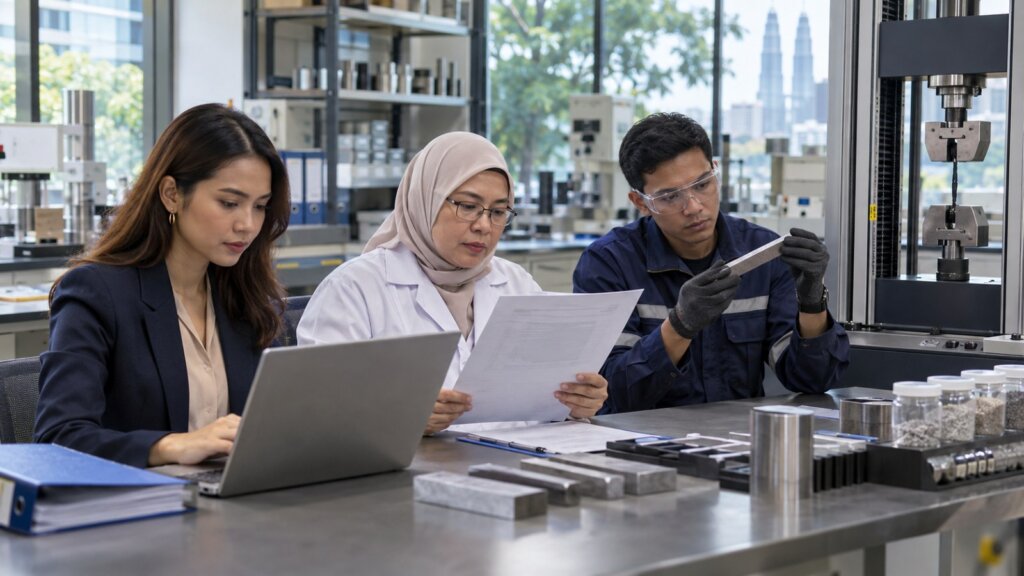
A manufacturer develops a material that performs exceptionally well under laboratory testing. A food producer receives a report showing an unusual product characteristic. A technology company completes independent performance testing that appears to demonstrate an outstanding result.
Each organisation may have a credible technical achievement. Yet an important question remains: does the laboratory report establish the exact result that the organisation wants recognised?
For companies considering an Asia Record application, the distinction matters. A laboratory report documents observations, measurements or test outcomes under defined conditions. A proposed record must communicate a clear achievement that can be assessed against supporting evidence.
The strongest submissions connect these two elements. They explain what was tested, how the result was obtained, which conditions applied and why the evidence supports the proposed claim.
This guide examines how manufacturers, research institutions, product developers and technology businesses can prepare laboratory test reports as supporting evidence for an Asia Record application.
When Can a Laboratory Test Report Support a Record Claim?
Laboratory reports may be relevant when an achievement depends on a measurable technical characteristic or performance result.
Potential examples include:
- A material tested for strength, durability or another measurable physical characteristic.
- A manufactured component evaluated for performance under defined operating conditions.
- A food product assessed for a specific measurable composition or property.
- An engineering product subjected to a repeatable technical test.
- A research prototype evaluated using an established measurement method.
- A consumer product whose claimed achievement depends on a quantifiable laboratory result.
These examples describe possible evidence situations, not approved Asia Record categories or pre-approved record titles.
Asia Record considers proposed achievements according to their measurable claims, supporting evidence and relevant verification conditions. The suitability of a particular laboratory-based achievement must therefore be assessed through the applicable process.
Applicants can review the official Asia Record verification process to understand how measurable claims and evidence are assessed.
A Laboratory Result Is Not Automatically a Record
Consider a hypothetical manufacturer that receives a laboratory report showing a product achieved a particular tensile strength during testing.
The result may be technically valid. However, several questions remain before it can support a broader record claim.
- Does the result apply to one sample, one production batch or the product generally?
- Which testing method produced the result?
- Were the conditions appropriate for the proposed comparison?
- Can the tested sample be linked to the product identified in the application?
- Were comparable products evaluated using equivalent methods?
- Does the proposed record title describe only what the evidence establishes?
A report showing that one sample achieved a particular result does not, by itself, establish that the product outperforms every comparable product in Asia.
The applicant must distinguish between the measured result and any wider conclusion drawn from it.
Seven Elements to Check in a Laboratory Test Report
The following is an editorial checklist for organising technical evidence. It is not an official universal Asia Record laboratory-report requirement.
1. Laboratory Identity
Identify the laboratory responsible for conducting the test and issuing the report.
Useful information may include its registered name, location, report reference, issuing department and contact details.
Where accreditation is relevant, applicants should verify the laboratory’s current accreditation status and the specific activities covered by its scope.
Accreditation demonstrates assessed competence for defined activities. It should not be described as automatic confirmation that every individual result is correct or that a particular record claim has been established.
2. Report Number and Issue Date
A clear report reference allows the evidence to be identified consistently across the application, supporting documents and communications with the laboratory.
Record the report number, testing date where available, issue date and any revision information.
If a corrected report is issued, retain the relevant document history and ensure the application refers to the appropriate version.
3. Sample Identification
The tested sample must be connected to the product, material or prototype described in the proposed achievement.
Useful identifiers may include a batch number, specimen code, serial number, product model or sample receipt reference.
For example, if a manufacturer submits a report concerning a specific product model, its supporting documents should explain how the tested specimen relates to that model.
Without this connection, a reviewer may be unable to determine whether the laboratory result supports the product named in the application.
4. Testing Method
The report should identify the method used to obtain the result, where applicable.
This may involve a recognised technical standard, a validated laboratory procedure or a specifically described test method.
The method matters because different procedures can produce different outcomes even when they appear to measure the same characteristic.
Applicants should avoid combining results from different methods without explaining whether those methods are technically comparable.
5. Testing Conditions
Performance results can depend on the conditions under which testing takes place.
Relevant variables may include temperature, humidity, pressure, loading conditions, operating speed, sample preparation and testing duration.
For example, a component tested under controlled laboratory conditions may perform differently during ordinary commercial use.
A record claim should not imply performance under conditions that were never tested.
6. Measured Result and Units
The report should identify the measured value and its relevant unit.
Applicants should preserve the precision and qualifications provided by the laboratory rather than converting a technical result into a more impressive marketing number.
If a report includes measurement uncertainty, detection limits, confidence information or qualifications affecting interpretation, those details should remain available to the reviewer.
A result expressed in one unit should also be converted carefully if the proposed record title uses another unit.
7. Report Conclusions and Limitations
Laboratory reports may contain important limitations on how their findings should be interpreted.
Some conclusions apply only to the samples tested. Others depend on a particular method, operating condition or defined specification.
Applicants should read these limitations before drafting a record title.
A statement such as “the tested sample achieved this result” may be supported by a report even when a broader claim about every product manufactured is not.
Laboratory Evidence Review Matrix
The following matrix helps applicants identify which documents may be useful before submitting a technical achievement for consideration.
| Evidence element | Question to answer | Potential supporting document |
|---|---|---|
| Laboratory identity | Who performed the test? | Original laboratory report |
| Sample identity | What was tested? | Sample receipt record or batch identification |
| Testing method | How was the result measured? | Test method reference or technical procedure |
| Testing conditions | Under what conditions was the test performed? | Test report or laboratory condition records |
| Measured result | What result was obtained? | Signed or authenticated test report |
| Product connection | How does the sample relate to the applicant’s product? | Manufacturing, product or sample traceability records |
| Claim comparison | Does the evidence support the proposed achievement? | Comparison methodology and relevant supporting evidence |
Not every application requires every document in this matrix. The appropriate evidence depends on the proposed achievement and the instructions issued for its assessment.
How to Connect a Laboratory Report to the Proposed Record Title
A useful way to evaluate technical evidence is to work backwards from the proposed record title.
Begin by identifying the exact statement that the organisation wants to establish.
Then identify which laboratory result supports that statement and what additional information is necessary to interpret it correctly.
Example: A Product Performance Claim
Imagine a company develops an industrial component and commissions an independent laboratory to evaluate its performance.
The laboratory reports a measurable result under specified test conditions.
The company initially wants to describe the product as the highest-performing component in Asia.
That broad claim introduces several questions that the original test may not answer. The company would need to establish the comparison category, relevant competitors or products, equivalent measurement conditions and a defensible basis for the superlative.
A more precise proposal would identify the actual tested performance characteristic, product scope and measurement conditions.
Even then, the proposed title would require assessment before any recognition could be assumed.
The central lesson is that the wording of a record claim must not exceed the evidence available to support it.
Why Sample Traceability Matters
Sample traceability is particularly important when testing takes place outside the applicant’s own premises.
A laboratory may receive a specimen with a sample code, conduct the required test and issue a technically sound report.
However, the applicant may still need to demonstrate that the specimen was genuinely connected to the product, batch or achievement described in the application.
Depending on the situation, useful supporting information may include:
- Sample identification records.
- Product model or batch documentation.
- Dispatch and laboratory receipt records.
- Sample preparation information.
- Photographs linking the sample to its identifier.
- Records explaining who selected and submitted the specimen.
For high-value technical claims, organisations should also consider whether the sampling method was representative and whether independent sampling would provide stronger evidence.
A valid laboratory result can still be insufficient for a broad claim if the tested specimen cannot be reliably connected to the achievement.
Understanding Laboratory Accreditation
Organisations sometimes assume that any report carrying an accreditation symbol is automatically sufficient evidence for record recognition.
This is not necessarily the case.
ISO/IEC 17025 is an internationally used standard concerning the competence of testing and calibration laboratories. In Malaysia, the Department of Standards Malaysia administers laboratory accreditation arrangements covering relevant testing and calibration activities.
Accreditation should be evaluated in relation to the laboratory’s approved scope. A laboratory may be accredited for certain tests without being accredited for every service it offers.
When a technical achievement depends on specialised testing, applicants should consider whether the relevant activity falls within the laboratory’s accreditation scope and whether the method is appropriate for the claim.
It is equally important to distinguish three separate matters:
- Laboratory competence: Whether the testing organisation has demonstrated competence for relevant activities.
- Test-result validity: Whether the particular result is technically supported and appropriately interpreted.
- Record recognition: Whether the proposed achievement satisfies the applicable Asia Record assessment and verification requirements.
These matters are related, but they are not interchangeable.
Asia Record recognition does not replace laboratory accreditation, product certification, regulatory approval or other legal and technical compliance obligations.
What If Different Laboratories Produce Different Results?
Different test results do not necessarily mean that one laboratory has made a mistake.
Differences may arise from specimen preparation, equipment, environmental conditions, test methods, measurement uncertainty or natural variation between samples.
Applicants should not automatically select the most favourable result and ignore the others.
Instead, they should establish whether the results are comparable and identify any differences that could affect the proposed achievement.
Where necessary, a qualified technical specialist may help explain the results, limitations and appropriate interpretation.
If testing results materially disagree, the organisation should resolve the technical issue before presenting a definitive claim.
Preparing a Laboratory Evidence Package
Technical evidence becomes easier to review when the documents follow a clear structure.
Applicants can use the following practical sequence.
Step 1: Write the Proposed Achievement Clearly
Describe the product, material, organisation or individual involved, together with the measurable result being proposed.
Identify the relevant unit, scope, date and testing conditions.
Step 2: Identify the Exact Supporting Result
Locate the relevant section, table or result within the laboratory report.
Avoid expecting a reviewer to search through an extensive technical document to determine which measurement supports the claim.
Step 3: Confirm the Sample Connection
Prepare the records that connect the tested specimen to the product or achievement.
Check that sample identifiers, batch references and report numbers are consistent.
Step 4: Explain the Testing Method
Provide a concise description of the method and any relevant testing conditions.
Where a recognised standard was used, identify it accurately without implying that compliance with the standard automatically establishes a record.
Step 5: Review Technical Limitations
Read the report’s qualifications, uncertainty information and conclusions.
Ensure the proposed record wording does not make claims beyond the tested conditions or available evidence.
Step 6: Prepare an Evidence Index
Create a document index that identifies the relevant reports and supporting records.
For example, the index might distinguish the original laboratory report, sample traceability documents, product specifications and technical explanation.
Preserve original reports and clearly identify any supplementary summaries or calculations.
Step 7: Submit the Proposal for Assessment
Applicants should follow the official Asia Record application process and provide the information relevant to their proposed achievement.
Asia Record may request additional material or clarification where necessary. Applicants should follow the evidence requirements communicated for their specific proposal.
Common Mistakes When Using Laboratory Reports
Claiming More Than the Report Establishes
A test result for one specimen should not automatically become a claim about every product in a range or every competing product in the market.
Using a Report Without Sample Identification
A technical result may be difficult to connect to the proposed achievement when the tested specimen cannot be identified reliably.
Ignoring Differences in Test Methods
Results obtained under different procedures may not be directly comparable.
Confusing Accreditation With Record Recognition
An accredited laboratory report can provide useful technical evidence, but it does not independently determine whether an Asia Record should be granted.
Submitting Only a Marketing Summary
Product brochures and promotional presentations may communicate an achievement, but original technical records are generally more useful for evaluating the underlying measurement.
Omitting Report Limitations
Qualifications about sample scope, test conditions or uncertainty may materially affect the claim. They should not be excluded merely because they make the result less impressive.
How Technical Achievements Can Become Credible Public References
Businesses invest considerable resources in research, product development, quality assurance and performance testing.
Some of those activities produce measurable results that may be suitable for record recognition consideration.
However, a compelling achievement narrative should begin with the evidence rather than with a promotional superlative.
For manufacturers, this means connecting technical measurements to identifiable products and defensible comparison conditions.
For research institutions, it means distinguishing experimental findings from broader conclusions.
For technology companies, it means documenting the tested configuration and operating environment.
For consumer-product businesses, it means ensuring that claims about performance, composition or durability remain consistent with the actual laboratory findings.
Where recognition is approved, the resulting public reference should describe the verified achievement accurately.
Readers can explore the official Asia Record Holder directory to see recognised achievements published through Asia Record.
Frequently Asked Questions
Can I use an independent laboratory report for an Asia Record application?
A laboratory report may be relevant supporting evidence when it helps establish a measurable achievement. Its suitability depends on the proposed claim and the applicable evidence requirements.
Must the laboratory be accredited?
Asia Record’s general published application guidance does not establish one universal laboratory accreditation requirement for every proposed achievement. Applicants should confirm the specific evidence requirements for their record. Accreditation may nevertheless be relevant to assessing technical competence and the reliability of particular testing activities.
Can an internal company laboratory report be submitted?
Technical reports and first-party evidence may be relevant depending on the proposed record. The assessment may require further supporting information or independent verification. Applicants should not assume that an internally produced report alone will be sufficient.
Is one laboratory test enough to establish a record?
Not necessarily. A single result may establish what happened to one tested specimen under defined conditions, but broader claims may require additional evidence, comparison information or testing.
What if the laboratory report is confidential?
Applicants should identify confidential information before submission and discuss appropriate handling arrangements through Asia Record’s official channels. Any necessary disclosure or supporting documentation should follow the applicable assessment requirements.
Can laboratory testing prove that a product is the best in Asia?
A laboratory result does not automatically establish such a broad claim. The proposed comparison would need to be clearly defined, technically appropriate and supported by sufficient evidence.
Where can I submit a laboratory-supported achievement?
Individuals and organisations can begin by reviewing the official Asia Record nomination information and submitting a measurable achievement for consideration.
From Technical Measurement to a Verifiable Achievement
A laboratory report can be a valuable foundation for a proposed record, particularly when the achievement depends on product performance, material properties or another measurable technical result.
Its value lies not simply in the number reported, but in the ability to establish what was tested, how the measurement was performed, which conditions applied and what the result actually means.
Companies and institutions considering recognition should preserve their original reports, organise the supporting technical documents and ensure that the proposed claim remains consistent with the evidence.
If your organisation has achieved an exceptional measurable result, submit your nomination through Asia Record’s official website for assessment and consideration.